
CELEBRITY
Alex Honnold’s “Embarrassing” Payday: Risking Life for Mid-Six Figures on Taipei 101

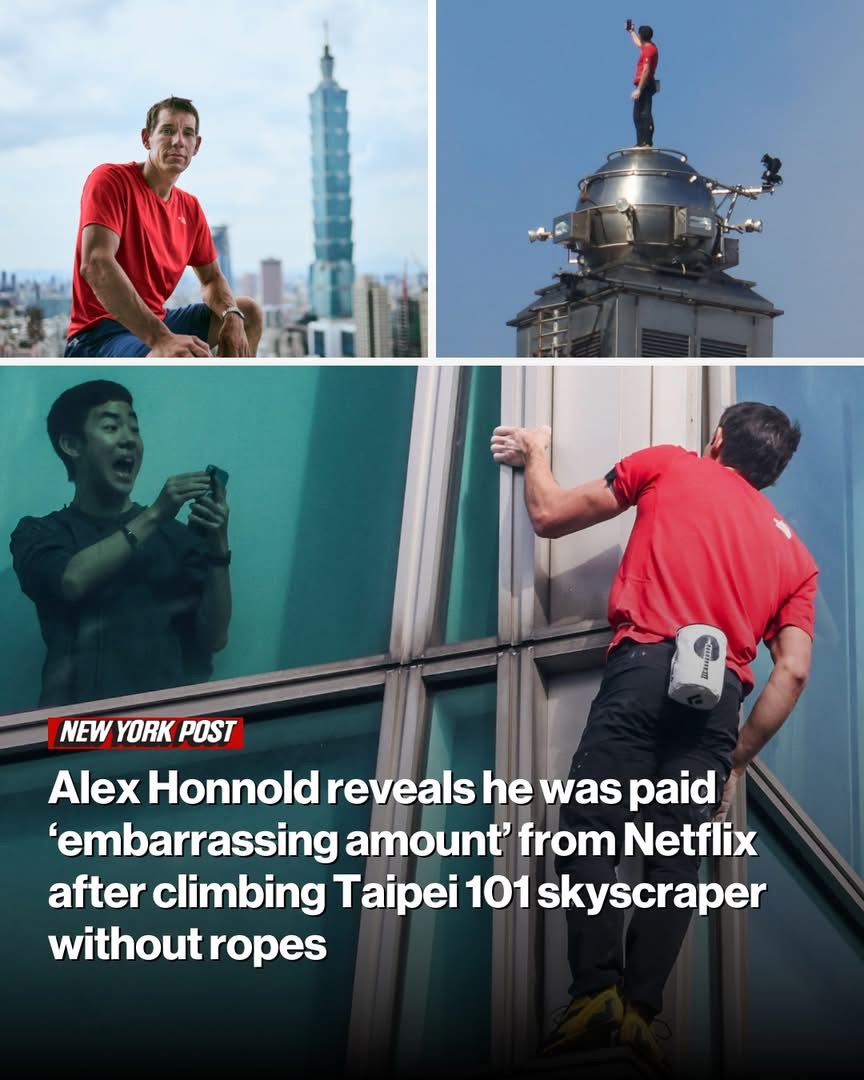
Alex Honnold’s “Embarrassing” Payday: Risking Life for Mid-Six Figures on Taipei 101
In a feat that left millions breathless, legendary free solo climber **Alex Honnold** scaled the iconic **Taipei 101** skyscraper—1,667 feet (508 meters) of sheer glass and steel—without ropes, harnesses, or any safety net. Broadcast live on Netflix as part of the special *Skyscraper Live*, the climb unfolded on January 24, 2026 (with a brief delay for viewer safety), taking the 40-year-old just over 1 hour and 31 minutes to reach the summit. Using tiny architectural ledges and metal outcroppings along one corner of the 101-story tower, Honnold turned what most would see as a suicide mission into a mesmerizing display of human precision and nerve.
The images capturing the event are nothing short of iconic: Honnold perched casually at the top, red shirt against the gleaming spire, arms raised in triumph with the sprawling Taipei skyline far below; another shot shows him balanced precariously on the antenna dome, wind whipping around him; and a gripping close-up of a bystander filming from inside as Honnold grips the building’s exterior, chalk bag swinging, focus unbreakable. These photos, splashed across headlines, scream both awe and disbelief—proof that the man who once free-soloed El Capitan has pushed boundaries even further.
Yet, behind the viral spectacle lies a surprising twist: Honnold called his Netflix paycheck an **”embarrassingly small amount.”** In interviews with *The New York Times* just before the climb, he compared it unfavorably to mainstream sports contracts, noting that even obscure Major League Baseball players can earn $170 million deals. Sources close to the arrangement confirmed the payment landed in the **mid-six figures**—roughly around $500,000—far less than what his agent had hoped for, and nowhere near the multi-million windfalls some might expect for such a high-stakes, life-on-the-line event.
Honnold was candid about his motivations, emphasizing that the money wasn’t the draw. “I’m not getting paid to climb the building,” he explained. “I’m getting paid for the spectacle. I’m climbing the building for free.” He went further, admitting he’d have tackled the ascent without any compensation if the building owners had simply granted permission—no cameras, no broadcast, just the pure challenge. For him, the real reward was the experience: the wind-swept view from the spire, the thrill of overhanging sections divided into grueling eight-floor bursts, and the rare crowd cheers echoing up from below—elements absent from his usual solitary wilderness climbs.
The modest payday has sparked fierce debate online and in the media. Critics argue it’s underwhelming for a death-defying live stunt that drew massive global viewership and generated huge buzz for Netflix—potentially far more profitable for the platform than for the climber risking everything. Supporters point out that Honnold’s drive has never been financial; his legacy, built on projects like the Oscar-winning *Free Solo*, stems from passion, not paychecks. Still, in an era where athletes command astronomical sums, $500,000 for dangling 1,667 feet above the ground feels like a stark undervaluation of the risk.
As Honnold descended safely and reflected on the “incredible” day, the climb cemented his status as one of the greatest boundary-pushers in extreme sports. But the conversation lingers: Is this the price of true daring in a spectacle-driven world? Or does it reveal that, for legends like Honnold, the summit itself is payment enough? One thing is clear—these jaw-dropping photos will inspire (and terrify) for years to come.

Common’s Wild Confession Backfires: Serena Williams Delivers the Ultimate Clapback That Broke the Internet

Shockwaves Across the Middle East: IRGC Commander Assassinated in Daring U.S.-Israel Airstrike

Iran’s New Supreme Leader: A Clear and Present Danger

Blazing Skies Over Tehran: US-Israeli Airstrikes Obliterate Mehrabad Airport in Fiery Assault

China’s Bold Ultimatum: End the War Now or Face Global Chaos!

Fatwa Fury: Iranian Grand Ayatollah’s Deadly Decree Against Trump Ends in Fiery US Airstrike Retaliation

Iranian Navy Flees: Second Warship Begs for Refuge in Sri Lanka After U.S. Torpedo Sends Frigate to the Bottom

Trump’s Bold Ultimatum: America Demands Veto Power Over Iran’s Next Supreme Leader

Barack Obama Seals $10M Netflix Bombshell: The Untold Saga of America’s Trailblazing Leader Unveiled!

Alex Honnold’s “Embarrassing” Payday: Risking Life for Mid-Six Figures on Taipei 101

India’s Imposition of 30% Reciprocal Tariffs on Select US Imports: A New Chapter in Bilateral Trade Tensions
